
Who was Denis Hurley
Early Life and Calling
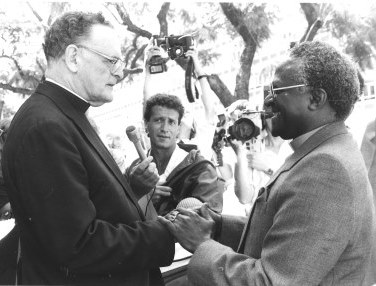
Denis Hurley was a courageous opponent of South Africa’s apartheid regime for 50 years, dubbed by opponents ‘the scourge of Apartheid’ and ‘an ecclesiastical Che Guevara’; the writer Alan Paton (noting Hurley’s father’s profession as a lighthouse keeper) called him the ‘Guardian of the Light’. As well as being a significant figure in the Struggle in South Africa, he also had great international influence within the Catholic Church. He was an instigator and then a champion of the ecclesiastical and liturgical reforms of the Second Vatican Council which he attended in the 1960s and regarded as the highlight of his life.
Born in Cape Town on 9 November 1915 of Irish parents, he joined the Catholic male religious order, the Oblates of Mary Immaculate (OMI) and was ordained a priest at the age of 24 after studying in Ireland and Rome. In 1947, at the age of only 31, he became the youngest Catholic bishop in the world and was elevated to be Archbishop of Durban in 1951 (and was also the youngest Catholic archbishop at that time).
Standing Against Apartheid
His career as an outspoken opponent of apartheid began in 1951 when, as chair of the Southern African Catholic Bishops’ Conference, he drafted the first of the ground-breaking pastoral letters in which the bishops denounced apartheid as ‘blasphemy’ and ‘intrinsically evil’.
Eventually along with four other South African religious leaders (including the Anglican Archbishop, Desmond Tutu), he was regarded as one of the South African state’s ‘most wanted’ political opponents. In 1984 he was charged with making false statements about the Koevoet counter-insurgency unit in Namibia. The prosecutor dropped the charges when it became clear that Hurley would be able to prove the truth of his statements.
Later Years and Legacy
He retired as archbishop in 1992, becoming Chancellor of the University of Natal from 1993 to 1998. He continued to work as parish priest of Emmanuel Cathedral well into his eighties and died on 14 February 2004 aged 88. His funeral, held at Kings Park stadium, was a major city event attended by national and international dignitaries and he is buried, following Catholic tradition, in the Cathedral (where he had worked as curate, bishop and administrator for 57 the previous 62 years), just to the right of the main altar.
Timeline of Denis Hurley
Date
Age
Event
9 November 1915
–
Born of Irish parents in Cape Town, South Africa
1924
9
Schooling at St. Elmo’s Convent, Umzumbe
1928, 1929
13-14
Schooling at St. Thomas’ School for Boys (Newcastle Dominicans), Newcastle
1930, 1931
15-16
Schooling at St. Charles’ College (Marist Brothers), Pietermaritzburg
1932
17
Novitiate of Oblates of Mary Immaculate, Ireland
1933
18
Began studies in Rome
1936
21
Obtained Licentiate in Philosophy at the Angelicum (now St. Thomas Aquinas University), Rome
9 July 1939
23
Ordained priest in Rome
1940
25
Obtained Licentiate in Theology at the Gregorian University, Rome
1940-1943
25-28
Curate at Emmanuel Cathedral, Durban
1944-1946
29-31
Superior of St. Joseph’s Scholasticate, Prestbury, Pietermaritzburg
12 December 1946
31
Named Vicar Apostolic of Natal with rank of bishop
19 March 1947
31
Ordained bishop, the youngest in the world at the time
11 January 1951
35
Appointed Archbishop, the youngest in the world at the time
1952-1961
37-46
President of the Southern African Catholic Bishops’ Conference
1961
46
Appointed to the Central Preparatory Commission of the Second Vatican Council
1962-1965
47-50
Attended Vatican Council and served as member of the Commission for Priestly Formation and Christian Education
1964
49
Appointed member of the International Commission on English in the Liturgy
1965-1966
50-51
President of the South African Institute of Race Relations
1965-1968
50-53
Member of the Liturgical Consilium, a Vatican body charged with implementing the Council’s decree on liturgy, Sacrosanctum Concilium
1967
52
Attended Synod of Bishops in Rome
1968
53
Convened first Synod of the Archdiocese of Durban
1969-1974
54-59
Member of the Sacred Congregation for Divine Worship
1970
55
Honorary Doctor of Laws, Notre Dame University, Indiana
1972
57
Civic Honours, City of Durban
1974
59
Attended Synod of Bishops in Rome; elected member of the Synod Council (charged with organising the next Synod)
1975
60
Elected Chairperson of the International Commission on English in the Liturgy
1975
60
Chevalier of the Legion of Honour (Légion d’Honneur), France
1976
61
Founded Diakonia, Durban ecumenical agency for social concern and action
1977
62
Founded the Human Awareness Programme
1977
62
Attended Synod of Bishops in Rome; elected member of Synod Council
1978
63
Honorary Doctor of Literature, University of Natal
1981-1987
66-72
President of the Southern African Catholic Bishops’ Conference
1982
67
Honorary Doctor of Humane Letters, Catholic University of America, Washington, DC
December 1983
68
Affiliated to the Marist Institute
9 October 1984
68
Charged with an offence under South African law for making “false statements” concerning atrocities committed by ‘Koevoet’ – a South African paramilitary police unit in Namibia.
18 February 1985
69
Acquitted when the prosecutor announced the State would not proceed with the trial, as the case was based on “rumour and hearsay evidence”
1985
70
Brought Supreme Court application which made legal history when it led to first court-ordered release of detainees held under Section 29 of Internal Security Act.
1986
71
Honorary member of Black Sash, a South African women’s anti-apartheid organisation.
1986
71
Honorary Doctor of Laws, De Paul University, Chicago
1986
71
Honorary Doctor of Sacred Theology, Santa Clara University, California
1987
72
Honorary Doctor of Humane Letters, Georgetown University, Washington, DC
1988
73
Honorary Doctorate, University of Leuven, Belgium
30 July 1989
73
Golden Jubilee of priestly ordination
23 June 1992
76
Resignation as Archbishop of Durban officially accepted on the appointment of his successor. Acting as Administrator of the Archdiocese until the installation of the new Archbishop.
4 October 1992
76
Retired when Bishop Wilfrid Napier OFM installed as Archbishop of Durban
1992
77
Appointed Parish Priest, Emmanuel Cathedral
1992
77
Freedom of the City of Durban
1993
78
Freedom of the City of Pietermaritzburg
1993-1998
78-83
Chancellor of the University of Natal
1993
78
Honorary Doctorate, Catholic Theological Union, Chicago
1996
81
Honorary Doctorate, St. Paul’s University, Ottawa
19 March 1997
81
Golden Jubilee of Episcopal ordination
1997
82
Order of Merit of the Italian Republic (Onorificenza de Grande Ufficiale)
1998
83
Named Paul Harris Fellow of the Rotary Foundation
10 June 1999
83
Order of Meritorious Service (Class 1), awarded by President Nelson Mandela
9 July 1999
83
Diamond Jubilee of priestly ordination
1999
84
Establishment of the Archbishop Denis E. Hurley Educational Trust by the University of Natal
2001
86
Golden Jubilee of appointment as Archbishop
2001
86
Honoured by the KwaZulu-Natal African Renaissance Committee as one of a number of community leaders invited to leave their handprint in a memorial in front of the Durban City Hall
2002
87
Retired as Parish Priest of Emmanuel Cathedral and went to live at Sabon House retirement home for Oblates of Mary Immaculate
13 February 2004
88
Died of cardiac arrest at Sabon House, Durban
27 February 2004
–
Buried in the Lady Chapel, Emmanuel Cathedral, after Requiem Mass at Absa Stadium, Durban
Short biographies
Download a PDF biography of Archbishop Hurley ‘Courageous and compassionate leader’
isiZulu version
English version
The following is a summarised extract from Archbishop Hurley’s biography ‘Guardian of the Light’ written by Paddy Kearney, published by Continuum (New York) in June 2009.
A Transformative Leader
Denis Eugene Hurley was undoubtedly the most significant Catholic leader in South Africa during the twentieth century. Appointed bishop one year before the National Party formed a government in 1948, he retired as archbishop in 1992, two years before the Nationalists ceased to be the ruling party, when the country’s first democratically elected government came to power. Hurley had a profound effect upon the Church’s struggle against apartheid and played a major role in the process of renewing the Catholic Church through the Second Vatican Council (1962-1965).
Tall and impressive, he was an eloquent speaker, years ahead of his time not only in his views on South Africa’s racial problems, but also on the reforms needed in the Catholic Church. His outspoken views on taboo subjects such as birth control, married priests and the ordination of women are thought to have prevented his being chosen as a cardinal, though many thought him eminently qualified.
Early Life and Formation
As a young matriculant in the early 1930s, Hurley shared the typical racial prejudices of white people of the day. He was a solid supporter of the British Empire and thought Mahatma Gandhi was spoiling things by his opposition to British rule in India. Gradually his attitudes changed as he opened himself to new ideas and admitted the inadequacies of his earlier thinking. He was always a keen learner, even in old age.
While studying for the priesthood in Rome, he was strongly attracted to the Church’s social teaching, though initially only in an academic and cerebral way. The official Church was nervous of anything that smacked of activism or revolution; Hurley seemed to reflect that nervousness. In his first assignment as a curate at Durban’s Emmanuel Cathedral in the early 1940s, immediately after his priestly studies and return to South Africa, he was a cautious young man. Though excited by attending a meeting about the establishment of black trade unions, he accepted the advice of older priests that this was not the sort of thing in which a priest should involve himself.
A few years later, however, as superior of St Joseph’s Scholasticate, he played an active role in the Pietermaritzburg Parliamentary Debating Society and enjoyed discussions with its wide range of members. His fellow staff members at St Joseph’s were young South African priests becoming concerned about the country’s racial policy. Hurley enjoyed discussions with them about the changes that would have to take place in South Africa; he introduced a course on social justice into the scholasticate curriculum so that priests in training would also confront these questions. But, by his own admission, the discussion and the training were still only theoretical. The staff were all white and, with one exception, so were the students, and there was little, if any, exposure to educated black opinion.
Rise to Leadership
Appointed a bishop at the extraordinarily young age of 31, he continued the discussions he began at St Joseph’s by organising a three-day conference for all the priests of the Natal Vicariate in 1948. This was the year the National Party came to power and began to implement hard-line racial segregation. The conference discussed these issues, though still in a remote and theoretical way.
When Hurley was appointed archbishop in 1951and president of the Bishops’ Conference in June 1952 (a position he held until early 1961), he persuaded the bishops to make their first-ever joint statement on human rights and race relations, despite the strong opposition of the papal representative, Archbishop Martin Lucas, and the latter’s confidential plea to him not to publicly criticise the government. The 1952 statement was important because it broke a long-standing episcopal silence on key racial issues, yet Hurley later acknowledged that it was “horribly patronising” towards black people. In that statement, and for many years after, the bishops favoured the idea of a qualified franchise. Such limited access to voting rights was not acceptable in progressive black circles.
In their desire for gradual evolution, the Catholic bishops were not in sympathy with the African National Congress (ANC), which wanted to force the pace of change through civil disobedience to apartheid legislation. The bishops regarded this campaign and its ANC sponsors, as Marxist and Communist-inspired. The Catholic Church was still cut off from ecumenical contacts, another potential source of more enlightened ideas. Other churches had their synods and assemblies, where black clergy and laity made known their views about the South African situation. There were no equivalent opportunities for Catholics.
Challenging Apartheid
The Catholic bishops’ eyes began to be opened by the Bantu Education Act of 1953, which directly threatened the mission schools – the Church’s main instrument of evangelisation. In a test of strength with the formidable Dr Hendrik Verwoerd, Minister of Bantu Education, Hurley and his colleagues decided not to hand over their schools to government, but to embark on an ambitious fundraising drive that would finance the schools for at least a few years after the withdrawal of government subsidies. Hurley led the Church through these difficult years, his confidence increased not only by high office but by the successful Marian Congress in South Africa. Its large outdoor rallies, services and processions were a dramatic change for a Church that had previously kept a low profile to avoid stirring up anxiety about the Roomse gevaar (‘Roman danger’).
In the 1950s and early 1960s Hurley remained, however, under the influence of the moderate approach of the South African Institute of Race Relations (SAIRR). This assumed that whites would act more justly towards blacks if they had the facts at their disposal. Little thought was apparently given to how blacks could achieve their own liberation.
Vatican II and Church Reform
The Second Vatican Council (1962 – 1965) was a major landmark in Hurley’s life. He was a significant participant from the beginning, having been chosen by Pope John XXIII as one of the 100-member Central Preparatory Commission that paved the way for this assembly of the world’s 2,500 Catholic bishops, the first in nearly a hundred years. Hurley revelled in the debates and discussions, but above all in the open and positive atmosphere, in which leading theologians updated the bishops through informal lectures and seminars. Despite coming from a remote and little-known diocese, Hurley came to be regarded as one of a small group who were responsible for the success of the Council. Its major documents gave new impetus to his views on Church reform and social justice, making him both a father and a son of Vatican II.
Hurley devoted the immediate post-Vatican II years to implementing the Council decrees in his own diocese, and in South Africa generally. Through the International Commission on English in the Liturgy (ICEL), the Interterritorial Meeting of Bishops in Southern Africa (IMBISA which linked all the Catholic bishops of eight Southern African countries), and the worldwide Synod of Bishops, he promoted the Council’s emphases on collegiality, lay participation, liturgy, catechetics, ecumenism and justice and peace.
Justice and Social Action
As a result of the Council, Hurley became more determined than ever in his opposition to apartheid, despite the South African government’s attempts to market their policy as an acceptable form of partition. There were in fact no black people in South Africa, they claimed: instead all blacks were citizens of one or other homeland, the only places where they would have political rights. Behind this sleight of hand was the stark reality: the majority of black people had never lived in the homelands, nor had any desire to do so. They would have starved were it not for their employment in South Africa’s urban areas. Moreover, their labour was key to the South African economy.
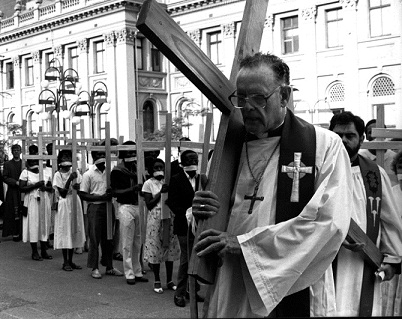
When Paul VI’s controversial encyclical on birth control, Humanae Vitae, was published in 1968, Hurley publicly stated that he did not agree. He was at that time involved in a fascinating private correspondence with the Pope, urging him with surprising frankness to involve his brother bishops in a more collegial resolution of this issue, especially through the Synod of Bishops. Sadly, the Pope did not accept this advice. While Hurley was engaged in this high-level international exercise, back in South Africa, he involved himself in the issue of forced removals, especially with the community of Limehill in Natal. The government was pressing ahead vigorously with apartheid policy, moving an estimated four million people to consolidate the homeland areas and abolish “black spots”, where relatively small numbers of black people were living, surrounded by white communities. Hurley took up the cause of these and other people who were forcibly removed, assisting them with erecting tents on the day of the move, and repeatedly challenging the government about the unhealthy conditions at Limehill, conditions which led to the early deaths of many children.
Black Consciousness, similar to the Black Power movement in the United States, began to win the support of Africans towards the end of the 1960s. Hurley saw it as one of the most important political changes in South Africa’s history, giving black people self-confidence, restoring their pride, and helping them realise that only they had the power to change their situation. Early in the 1970s, workers began to stand up for their rights, beginning with the landmark Durban strikes of 1973. Hurley’s thinking began to alter: it became clear that more was needed from the Church than attitude-change among whites, important as that was. Impressed by the power of unionised workers to effect change in a disciplined, non-violent way, he publicly backed them.
At the same time, there were important initiatives that white people could undertake, most notably conscientious objection to military service in the apartheid army. Hurley’s strong support for those who declared such objection and faced the consequences, highlighted their significant contribution to peace-making but made him unpopular with the government and many whites.
Organising for Change
To Hurley, apartheid was a form of organised evil, which he believed could only be overcome by organised good. Thus, in the 1970s, he established organisations that would help to bring about change. He founded Diakonia (1976), an ecumenical agency promoting action for justice and peace in the Greater Durban Area; initiated the Human Awareness Programme (1977) which strengthened civil society efforts; and supported the establishment in 1979 of PACSA (the Pietermaritzburg Agency for Christian Social Awareness). Through his contacts with leaders of other churches and other faiths, his ecumenical commitment grew ever stronger. The dynamic ecumenical movement in KwaZulu-Natal even now owes much to his pioneering efforts.
National Leadership
As president of the Bishops’ Conference for a second period – from 1981 to 1987 – Hurley was once again in the national limelight. During these years, Hurley’s leadership was key to major reports published by the Conference highlighting the situation in Namibia (then called South-West Africa), the problem of forced removals, and the extensive use of violence by the police in black townships of the Vaal Triangle. He led the bishops in outspoken and practical support to trade unions in their struggle for worker rights.
As a result of comments he made at the launch of the report on Namibia, he was charged with libelling the police anti-insurgency unit known as Koevoet (crowbar). Only days before the case came to court in 1985, the charges were dropped. The government had realised they were taking on a formidable opponent, with widespread local and international support, whose prosecution would only draw attention to the illegality of South Africa’s presence in Namibia and the gross human rights abuses of which its security forces were guilty.
During the latter years of apartheid, when his own ministry as Archbishop of Durban was coming to an end, Hurley made efforts to unite church initiatives to promote change, through “Christians for Justice and Peace”. Unfortunately it did not win sufficient support from the black community. Much more successful was his promotion, throughout the Catholic Church in South Africa, of a “Pastoral Plan” with the motto “Community Serving Humanity”.
Democracy and Renewal
1990 was a momentous year for South Africa, with the unbanning of the liberation movements – the African National Congress (ANC) and the Pan Africanist Congress (PAC) – and the release of Nelson Mandela after 27 years of imprisonment, events that gave Hurley great joy. Decades of struggle for racial justice in South Africa had not been in vain. In 1994 came the first democratic elections and the installation of Nelson Mandela as president of South Africa an event that Hurley saw as a highlight of his life second only to the Second Vatican Council.
Retirement and Continuing Service
When Hurley retired as Archbishop of Durban in 1992, he worked as parish priest of Emmanuel Cathedral where he had begun his pastoral ministry in 1940. During nine years of ‘retirement’ in this demanding post, in addition to being Chancellor of the University of Natal, he was for several years a Patron of Jubilee 2000, a campaign to have the debt of poor nations cancelled and to counter economic globalisation. This was a return to Hurley’s early interest in economic justice when he wrote a dissertation on “Economic Domination through Credit Control” at the Gregorian University in the late 1930s.
A Legacy of Hope
In the last years of his life, as South Africa took rapid strides towards democracy, it was ironic that the Catholic Church was retreating from many of the progressive positions of Vatican II. ICEL, which Hurley helped found in 1963, and to which he had given nearly 40 years of service, 16 of them as Chair, came under attack from the Vatican’s Congregation for Sacred Worship, eventually being restructured and having its mandate and the whole process of translation substantially altered.
These were painful experiences for Hurley, yet he remained a man of hope, sustained by his frequent meetings with the Rome-based lay Community of Sant’Egidio, which he regarded as an embodiment of the vision and ideals of Vatican II, strongly based on daily community prayer. He was particularly impressed that their efforts to promote justice and peace stemmed from their friendship with marginalised communities and countries and that they were linked to ongoing welfare and development work. This continuum of Christian effort, he felt, provided a model for the whole Church.
Less than a week before his sudden death on 13 February 2004, he had attended one of Sant’Egidio’s assemblies where cardinals and bishops, as well as laity, met for several days with leaders of other churches and faiths to discuss efforts to promote peace. He was comforted by the realisation that the values of Vatican II were alive and well. In the Sant’Egidio gatherings, he glimpsed the possible shape of future councils, indeed he tasted what the Church of the future might be like. He returned from Rome in February 2004 unusually happy: despite his disappointments with the official Church, it seemed as if his life journey was ending on a high note – there was hope for the future.