
Hurley and Social Justice
Introduction
From the time of his studies in Rome in the latter part of the 1930s, when Denis Hurley was introduced to the social encyclicals of Popes Leo XIII (Rerum Novarum) and Pius XI (Quadragesimo Anno), his great passion was the promotion of social justice.
Returning to South Africa as a newly-ordained priest in 1940, he immediately saw the relevance of what he had learnt about the Church’s social teaching to the situation in this country. He was also struck by the appropriateness of the Young Christian Workers’ (YCW) “see-judge-act” methodology and would have liked to become a YCW chaplain.
From Theory to Action
Initially his passion for social justice as a curate at Emmanuel Cathedral, as superior of St Joseph’s Scholasticate, and even as a young bishop, was largely intellectual and academic. Though he could see the need for change, he was not in any way an activist but called for evolutionary steps towards a just society.
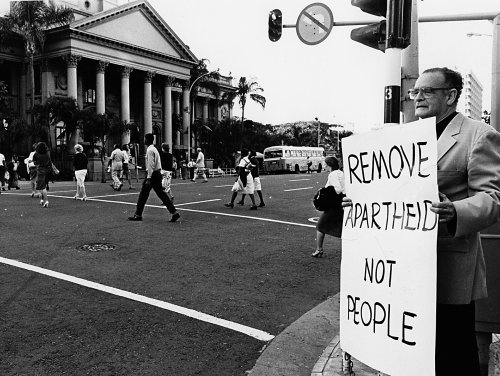
As he was increasingly exposed to the effect of apartheid injustice on ordinary people, he became aware that a more dynamic and engaged response was called for. This was especially so after Vatican II and its decree on The Church in the Modern World. Direct contact with suffering people moved him to take up the cudgels on their behalf and be prophetic in word and action.
He was delighted by the document “Justice in the World” which emerged from the Synod of 1971, and took to heart its famous words: “Action on behalf of justice and participation in the transformation of the world fully appear to us as a constitutive dimension of the preaching of the Gospel.”
The Church and Social Issues
In an address at St Joseph’s Church, Morningside, Durban during 1986, the year in which South Africa’s apartheid crisis reached its zenith, the archbishop set out simply and clearly the Church’s relationship to the world of politics and social issues. He described the failure of the Church to deal with the social issues arising from the Industrial Revolution.
In the address, he explained how Pope Leo XIII’s Rerum Novarum began to address those issues, especially wages, for the first time. The archbishop emphasised the critical role played by Joseph Cardijn’s ministry among young factory workers in Belgium in the 1920s and how he developed the “see-judge-act” methodology which has become a crucial way of responding to socio-political issues.
Lasting Legacy
Students from St Augustine’s now in their 60s, 70s and 80s remember fondly their school days in the old building. They have been especially supportive in fund-raising for the Denis Hurley Centre. One way in which a link to the old building is retained is in the use on the 1st floor of bricks, iron work and wooden stair banisters, incorporated into the new Denis Hurley Centre by a retired Master Builder, Tony Stals, who was a pupil at the school 60 years ago. The 1st floor cafe is named ‘St Augustine’s Cafe’ and will contain a tribute to the pupils and staff of the school.
A Continuing Challenge
In the first “Archbishop D. E. Hurley Lecture,” delivered by the archbishop himself in 1995, he addressed the concern that Justice and Peace is “sidelined” in the Church, and urged that the Church should become a “happier place” for these values that are integral to christian living.
Hurley and Vatican II
Archbishop Hurley played an important role in the Second Vatican Council (1962-1965). It was a most important experience for him, and a topic on which he was always excited to deliver a lecture. The important role of the Archbishop can be seen at a glance by consulting the index of the G. Alberigo and J. A. Komonchak, History of Vatican II, where the Hurley name appears several times in each of the volumes. In fact, already in 1965, a series of 24 booklets was published entitled, The Men who Made the Council, and one of these was devoted to Archbishop Hurley (D. Fisher, Archbishop Denis Hurley).
As it was such an important experience in his life, Hurley devoted much care to this period in his memoirs, as can be seen in his Vatican II: Keeping the Dream Alive (Cluster 2005). 2009 was the 50th anniversary of the Pope John XXIII ‘s calling of the Council (25 January 1959) and the challenges faced then are ever more relevant.
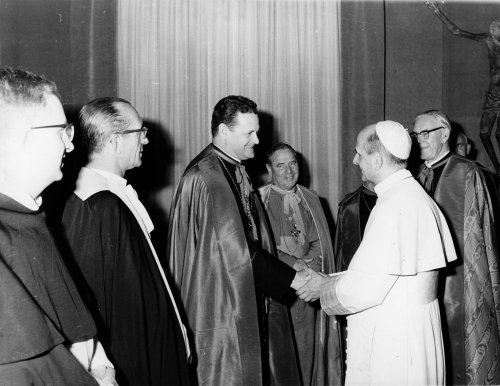
Archbishop Denis Hurley with Pope Paul VI during Vatican II—a defining era that shaped Hurley’s legacy as one of the prominent “Men Who Made the Council.”
Hurley and HIV/AIDS
As early as 1987, Archbishop Hurley established an AIDS Committee for the Archdiocese of Durban – one of the first South African church leaders to take the issue seriously. He had been influenced by a talk he heard given by Father Ted Rogers to a plenary session of the SACBC, a Jesuit from Zimbabwe. Hurley’s pioneering work on HIV/AIDS was done with much assistance from Liz Towell, who gave up her job with the Department of Health to head AIDS work in the Archdiocese.
In an interview she described what impressed her about Hurley’s approach: he urged Towell and her team of volunteers to emphasise love and care for people dying of the disease rather than any form of judgment; he emphasised the importance of conscience in decisions relating to the disease and preventing its spread; how rapidly he was able to establish a dynamic programme for the whole diocese; how he kept himself up-to-date by reading whatever research reports he could find; and how much sympathy and understanding he had about the plight of African women in relation to the disease.
After he had retired as archbishop and was working at Emmanuel Cathedral he invited Towell to speak on AIDS at all Masses and to be “100% forthright and accurate.” Above all she was impressed by his humility: “he doesn’t need to impress anyone”.
Hurley and Liturgy
One of the most obvious reforms of Vatican II, in which Archbishop Hurley played such a key role, was the reform of the liturgy and the document Sacrosanctum Concilium reform of the liturgy and the document (1962) which urged ‘full and active participation’ by the laity. This led to the need for the texts of the Mass and other services in languages other than Latin (‘vernacular’) and it was recognised that there should be one common English translation that could be used across all countries rather than each Bishops’ Conference creating its own.
Thus ICEL (the International Commission on English in the Liturgy) was founded in part with Hurley’s help in 1963. He gave ICEL nearly 40 years of service, 16 of them as Chair, and oversaw the introduction of widely accepted texts for all parts of the Catholic liturgy.
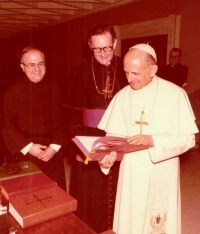
Fr Gil Ostdiek
Member of ICEL 1986-1999
However, the technique used of ‘dynamic translation’ – to capture the meaning of the original but in natural modern English – came under attack from the Vatican’s Congregation for Sacred Worship at the turn of the Millennium under the Papacy of Benedict XVI. It was felt that the English version should stick more closely to the structure of the Latin and use Latinate terms (e.g. ‘consubstantial’ rather than ‘one in being’) especially since translations into many smaller languages were based on the English text not the Latin. Eventually ICEL was restructured and its mandate and the whole process of translation substantially altered and much of the work of Hurley on translations was undone.