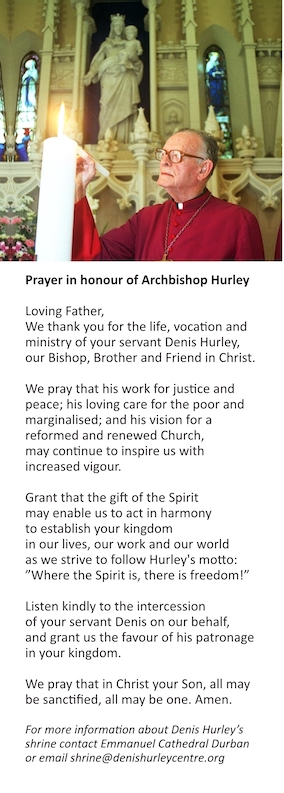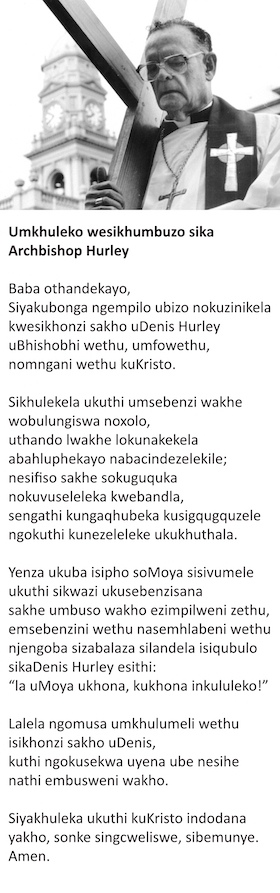
Shrine in honour of Archbishop Denis Hurley
Read the Southern Cross editorial ‘Sainthood for Denis Hurley?’
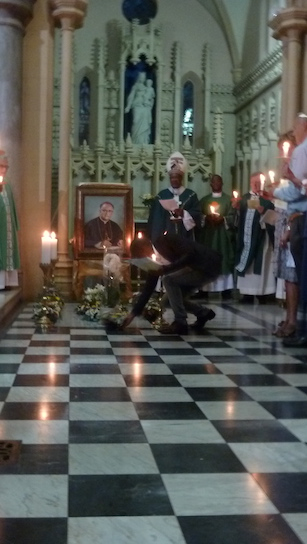
When he died in 2004, the beloved Archbishop Denis Hurley was buried in Emmanuel Cathedral, Durban. His grave lies to the right of the sanctuary, just in front of the statue of Our Lady to whom he had a special devotion as an Oblate of Mary Immaculate.
At a Memorial Mass in February 2017, on the occasion of Hurley’s death anniversary, Wilfrid Cardinal Napier OFM, his successor as Archbishop of Durban, announced permission for the creation of a shrine in Hurley’s honour to “encourage public devotion that would be evidence for the Archdiocese to start the cause for his canonisation”. Click here to find out more about the offical process of becoming a saint.
A specially commissioned prayer has been endorsed by the Cardinal for use at the Shrine, or elsewhere, to ask for Hurley’s intercession. Copies of the prayer on a laminated bookmark can be purchased at a cost of R40 for 20.
A permanent exhibition about the life and ministry of Denis Hurley, including a number of relics associated with him, is in on display next door to the Cathedral in the Denis Hurley Centre, a living legacy to Denis Hurley
- The shrine is accessible when the Cathedral is open, 7 days a week: 6am-6pm (except during services).
- The exhibition is accessible when the Denis Hurley Centre is open, 7 days a week 8am to 5pm.
- Tours for groups are available on request: please email shrine@denishurleycentre.org. Safe parking is available behind the Cathedral.
It is the custom among Catholics that a bishop be buried in the Cathedral where he presided. Hurley’s grave joined the graves of two former bishops/vicars apostolic of Durban: Charles-Constant Jolivet OMI (who served 1874-1903) and Henri De Lalle (1903-1949). In fact, Hurley had been associated with this building for over 60 years— not just as bishop and then archbishop (1947-92), but as a recently ordained curate (1940-43) and then, in his retirement, as Administrator (1992-2002; the Catholic equivalent of a Cathedral Dean).
The Shrine was inaugurated on Sunday 17 March 2017, exactly 70 years after Hurley was consecrated as bishop in the same Cathedral, by Bishop Barry Wood OMI, auxiliary bishop of Durban. During that weekend, it was blessed in addition by Monsignor Paul Nadal (Hurley’s Vicar General) and fellow Oblates, Fr Chris Richmond OMI, Fr John Paterson OMI (who at 93 is a near contemporary of Hurley) and Fr Vusi Mazibuko OMI (Natal Provincial). At the Masses honouring Hurley during that weekend, his mitre and crozier (symbols of his authority as a bishop) were brought in procession and placed on the grave. During the Eucharist, a chalice was used that had been a gift to mark Hurley’s consecration as bishop from the Marist Brothers at St Charles College, Pietermaritzburg (Hurley’s old school).
Durban City Council have recognised Hurley’s importance with a street and now a museum dedicated to him; the Church is now formally encouraging us to pray for his intercession by the creation of this shrine. It is clear that he is an inspiration to Catholics and to citizens of all faiths and persuasions.
(Paddy Kearney, Hurley’s biographer)
Pope Francis keeps reminding us that we are the Church of the Poor. Hurley’s example drives the work for the marginalised that continues in his name. With our prayers, and the work of the Spirit, perhaps in time he will be St Denis of Durban, patron of the poor.
(Raymond Perrier, Director of the Denis Hurley Centre)
The process of becoming a saint
A person becomes an official saint when she or he is canonised. The process of canonisation was established over 800 years ago by Pope Gregory IX as a way of ensuring that the person was truly worthy of being called a saint. The Congregation for the Causes of the Saints oversees the entire process.
When a person dies who has “fame of sanctity” or “fame of martyrdom,” the Bishop of the Diocese usually initiates the investigation. One element is whether any special favour or miracle has been granted through this candidate saint’s intercession.
When a person dies who has “fame of sanctity” or “fame of martyrdom,” the Bishop of the Diocese usually initiates the investigation. One element is whether any special favour or miracle has been granted through this candidate saint’s intercession.
Throughout this investigation the “general promoter of the faith,” or devil’s advocate, raises objections and doubts which must be resolved.
If the candidate was a martyr, the Congregation decides whether she or he died in a sacrifice of love for Christ and the Church.
In other cases, the Congregation decides if the candidate was an exemplary, charitable and heroic individual. The candidate’s writings are also investigated to see if they possess “purity of doctrine,” essentially, nothing heretical or against the faith. All of this information is gathered, and submitted to the Congregation for their deliberation.
Once a candidate is declared to have lived life with heroic virtue, he may be declared Venerable.
The next step is beatification. A martyr may be beatified and declared “Blessed” by virtue of martyrdom itself. Otherwise, the candidate must be credited with a miracle. In verifying the miracle, the Church looks at whether God truly performed a miracle in response to the intercession of the candidate saint. Once beatified, the candidate saint may be venerated but with restriction to a city, diocese, region, or religious family. Accordingly, the Pope would authorise a special prayer, Mass, or proper Divine Office honouring the Blessed.
After beatification, another miracle is needed for canonisation and the formal declaration of sainthood.
God shows to men, in a vivid way, His presence and His face in the lives of those companions of ours in the human condition who are more perfectly transformed in the image of Christ. He speaks to us in them and offers us a sign of this kingdom to which we are powerfully attracted, so great a cloud of witnesses is there given and such a witness to the truth of the Gospel. It is not merely by the title of example that we cherish the memory of those in heaven; we seek rather that by this devotion to the exercise of fraternal charity the union of the whole Church in the Spirit may be strengthened (Vatican II ’Lumen Gentium’ No. 50).
Adapted from
Saunders, Rev. William. “The Process of Becoming a Saint.” Arlington Catholic Herald.
Hurley prayer of intercession
Wilfrid Cardinal Napier OFM, Denis Hurley’s successor as Archbishop of Durban, announced permission for the creation of a shrine in Hurley’s honour to “encourage public devotion that would be evidence for the Archdiocese to start the cause for his canonisation”. Cardinal Napier also endorsed a specially commissioned prayer for use at the Shrine, or elsewhere, to ask for Hurley’s intercession. Copies of the prayer in isiZulu or English, on a laminated bookmark, can be purchased at a cost of R40 for 20.